
Google Launches AI Flight Deals Amid Monopoly Probe
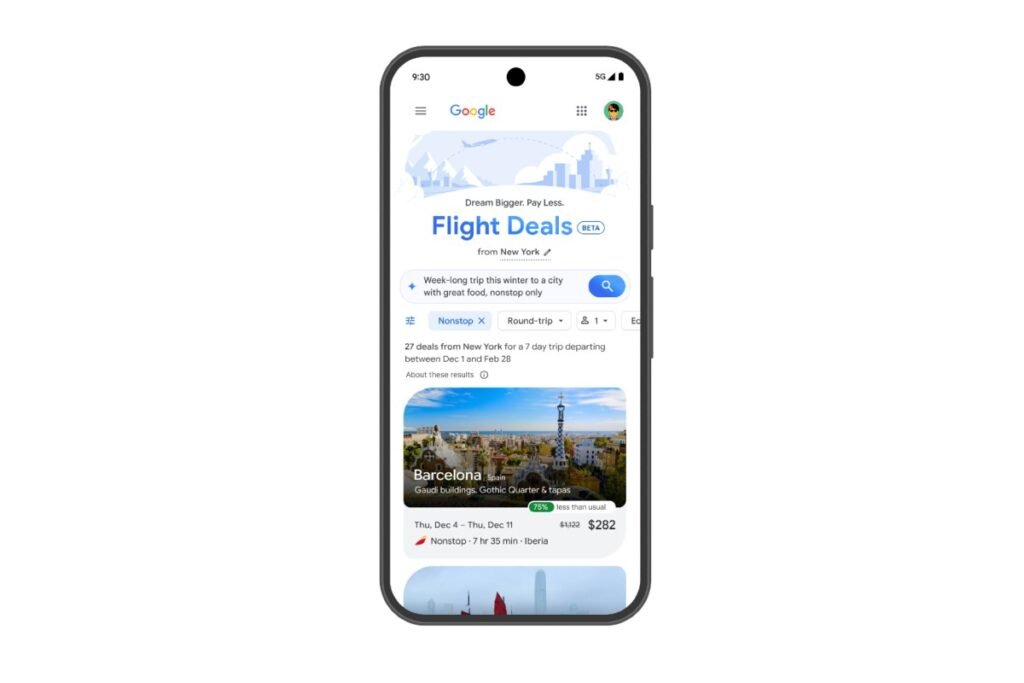
Google launched a new generative AI-powered search tool called “Flight Deals” on Thursday in the US, Canada, and India to help flexible travelers find cheap airfares, defying intensifying global antitrust investigations into its dominance over travel discovery.
The new feature is integrated directly into Google Flights to assist travelers with open schedules in securing the lowest possible fares. Users can input natural language queries into a dedicated search bar, describing their travel preferences and timing to receive tailored destination recommendations from the AI.
According to Google, travelers can use highly specific prompts such as “week-long trip this winter to a city with great food, nonstop only” or “10-day ski trip to a world-class resort with fresh powder” to surface matching options.
How Google’s Gemini-Powered Search Works
The search giant confirmed that Flight Deals is powered by a custom version of its Gemini 2.5 model. To ensure accuracy, the tool pulls real-time pricing data directly from airlines and travel partners. While the pricing matches existing Google Flights data, the AI’s primary role is to interpret conversational search queries and map them to relevant, budget-friendly destinations.
Algorithm Ranking and Pricing Dynamics
The tool prioritizes search results based on the depth of the discount, displaying the highest percentage of savings at the top of the page. If multiple deals offer the same percentage of savings, the system ranks them by the lowest absolute price. Any flight options that do not feature a specific savings badge are organized strictly by the lowest cost.
Because airline ticket prices fluctuate constantly, Google noted that deal availability and rankings within the tool will vary dynamically throughout the day.
Antitrust Pressure and Regulatory Challenges
The launch comes at a sensitive time for Alphabet, as antitrust regulators—including the European Commission—scrutinize Google for allegedly prioritizing its own search products, like Google Flights, to the detriment of independent competitors. European regulators are currently evaluating Google’s compliance under the strict Digital Markets Act (DMA), which aims to curb the market power of dominant tech gatekeepers. To mitigate potential penalties, Google is reportedly planning to propose changes, which may include displaying a neutral price-comparison box within standard search results.
Rollout, Privacy, and the AI Travel Race
Currently in beta, Flight Deals is rolling out over the next week to users in the United States, Canada, and India. Google stated that this initial phase will allow the company to collect user feedback and refine how generative AI handles complex travel planning.
Regarding user privacy, Google confirmed that queries processed through the new tool will be treated as part of the user’s search history. Users retain full control over this data and can manage or delete their Flight Deals search history at any time via the MyActivity dashboard.
This rollout highlights Google’s ongoing effort to defend its search dominance against AI-first competitors like OpenAI, Anthropic, and Perplexity. Traditional travel platforms have also moved quickly; competitors like Booking.com, Expedia, and Indian travel giant MakeMyTrip have already deployed proprietary AI assistants. While Google is entering the generative travel space later than some rivals, its massive global footprint could give it a decisive advantage if the tool gains widespread adoption.
Updates to Legacy Google Flights
For users who prefer a traditional search experience, the classic Google Flights interface—originally launched in 2011—remains fully active. In tandem with the AI rollout, the legacy platform is receiving an update that allows travelers in the U.S. and Canada to explicitly filter out basic economy fares from their search results.