Finom Raises €115M to Dominate European SMB Banking
Amsterdam-based challenger bank Finom has secured a €115 million (approximately $133 million) Series C equity round to aggressively expand its financial platform for small and medium-sized enterprises (SMBs) across Europe.
While venture capital remains tight for many in the current economic climate, Europe’s high-performing startups continue to attract massive investments. Finom’s latest funding milestone comes just weeks after securing $105 million in growth capital from General Catalyst, a key backer since 2021. The five-year-old fintech, which claims to have doubled its revenue in 2024, is capitalizing on strong investor appetite to fuel its next phase of growth.
A Major Capital Boost for European SMB Banking
Finom’s business model revolves around offering European SMBs a unified financial operating system that integrates banking, invoicing, and advanced features like AI-powered accounting. According to CEO Andrew Petrov, the ultimate vision is to streamline operations so thoroughly that entrepreneurs may eventually not require traditional accounting services at all.
This ambitious product roadmap supports the company’s aggressive growth targets. While Petrov admits that reaching one million business clients by the end of 2026 is a motivational target rather than a strict mandate, the newly acquired Series C capital brings that milestone significantly closer to reality.
The investment round was led by AVP (formerly AXA Venture Partners), with participation from Headline Growth, a division of new investor Headline (formerly e.ventures). Existing backers, including Cogito Capital, General Catalyst, and Northzone, also reinvested in the round, signaling strong confidence in Finom’s market opportunity among Europe’s 26 million SMBs.
Navigating a Competitive Fintech Landscape
Despite its impressive momentum, Finom faces a distinct market dynamic. The startup sees its primary opportunity in poaching clients from slow-moving traditional banks rather than engaging in direct market-share battles with established fintech giants.
With this Series C round bringing Finom’s total funding to roughly $346 million, the company still operates with a leaner capital base compared to heavyweights like Monzo, N26, Revolut, or Wise, each of which has raised well over $1 billion. Finom’s funding scale aligns closely with French competitor Qonto, which has raised approximately $700 million, though the two companies operate under different regional dynamics.
The Strategic Leverage of Non-Equity Growth Capital
A highly unique aspect of Finom’s capital structure is its blend of traditional equity and non-dilutive funding. General Catalyst’s recent growth round utilized its Customer Value Fund (CVF), a non-traditional mechanism where the VC took zero equity. Instead, this capital is strictly earmarked for customer acquisition and growth, with the fund recouping its investment directly from the revenue generated by those marketing efforts.
According to chairman and co-founder Kos Stiskin, the combination of the Series B and this non-dilutive growth capital would have been sufficient to guide the Dutch neobank to profitability. However, the leadership team also aimed to close an equity round by year-end to secure a fresh, premium valuation. Ultimately, both deals closed in rapid succession.
Stiskin noted that while one transaction took longer than anticipated, the other progressed much faster. Although he declined to reveal the exact valuation details, he confirmed that the new figure is double the undisclosed valuation from Finom’s $54 million Series B round earlier in 2024.
This rapid sequence of deals likely benefited from the due diligence conducted by General Catalyst. Because Finom does not publicly disclose its unit economics beyond its current user base of 125,000, General Catalyst’s deep-dive assessment served as a strong quality signal, encouraging other Series C investors to move quickly.
Expansion, Licensing, and AI-Driven Automation
While the non-equity growth fund handles marketing, the Series C capital will be deployed toward higher-risk strategic initiatives, including opportunistic acquisitions. This marks a notable shift for Finom, which has only completed one acquisition to date: the 2022 purchase of Kapaga, a UK-based cross-border payments provider.
Since then, Finom has pivoted away from the highly saturated UK market to focus on mainland Europe’s largest economies, including the Netherlands, France, Germany, Italy, and Spain. The company believes these regions suffer from poor SMB service by legacy banks and feature less intense challenger bank competition.
Finom operates primarily under an Electronic Money Institution (EMI) license in these core markets, having transitioned away from its partnership with Germany’s Solaris earlier this year. Despite not holding a full banking license, the fintech successfully launched lending products in the Netherlands, using the market as a testing ground for broader credit offerings across Europe.
To support this expanding product suite, Finom is actively integrating artificial intelligence both externally and internally. Rather than aggressively scaling its 500-person workforce, the company is deploying specialized internal AI agents to automate routine administrative and technical tasks, allowing the startup to remain highly efficient as it grows.
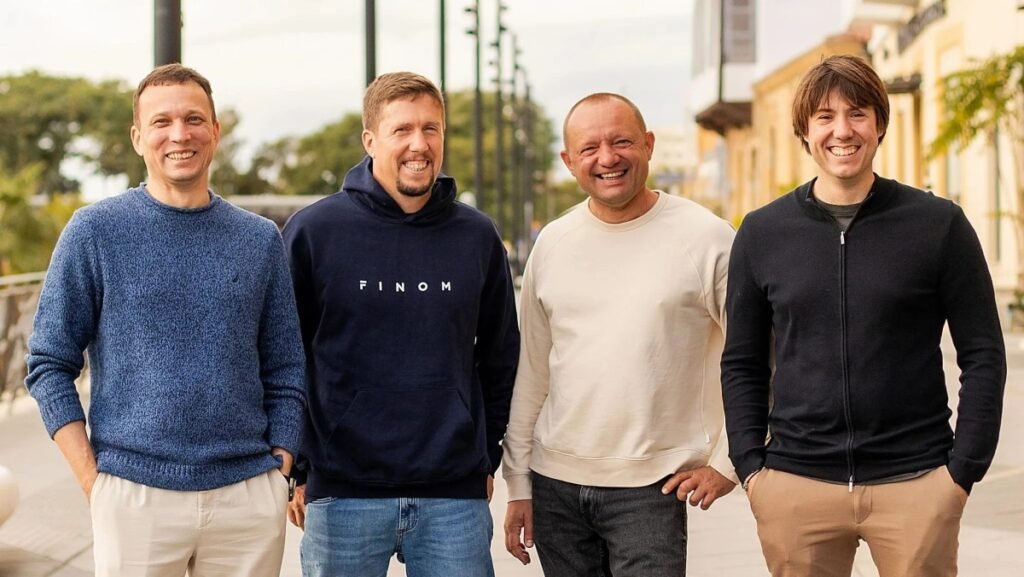
The company’s leadership has also streamlined, with Andrew Petrov now serving as the sole CEO. Alongside co-founders Yakov Novikov, Oleg Laguta, and Kos Stiskin—who previously built the Russian digital bank Modulbank—the team is fully focused on empowering European entrepreneurs, whom Stiskin describes as the absolute backbone of the European Union economy.
This story was updated to clarify Finom’s current licenses.