
ChatGPT Shopping Is Here: India Pilots AI Payments
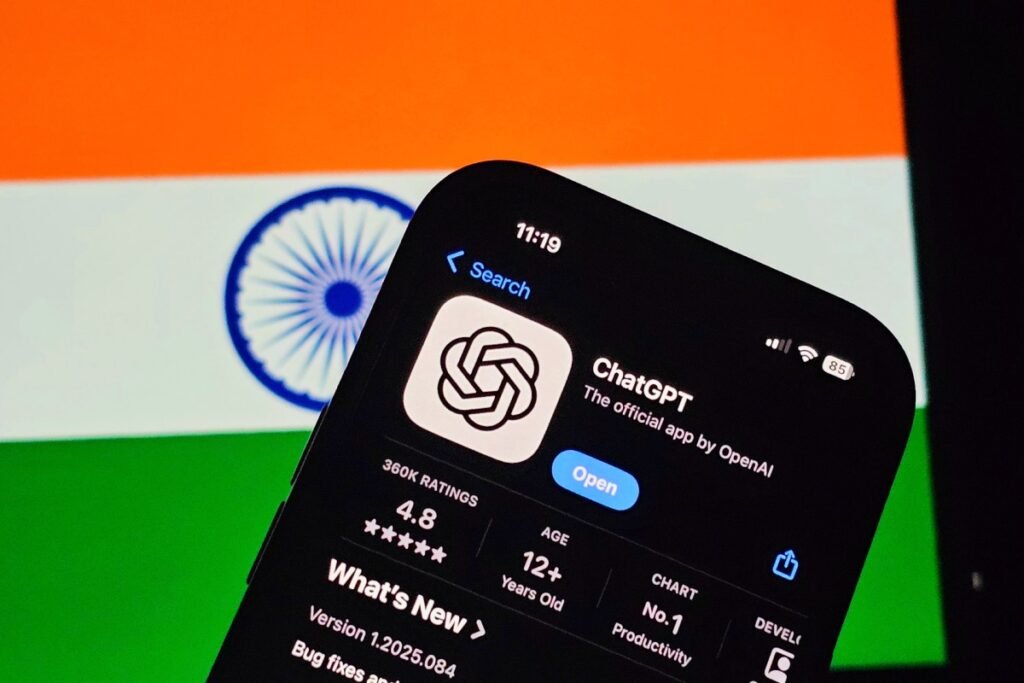
On Thursday, the National Payments Corporation of India (NPCI) launched a nationwide pilot in India allowing consumers to shop and pay directly inside OpenAI’s ChatGPT, leveraging the country’s Unified Payments Interface (UPI) to pioneer a new era of AI-driven conversational commerce.
This groundbreaking initiative, developed in partnership with leading fintech firm Razorpay, marks a significant milestone as India positions itself as the premier testing ground for global artificial intelligence giants. While OpenAI’s ChatGPT leads the initial rollout, integrations with Google’s Gemini and Anthropic’s Claude are already in active development, with a wider public release scheduled for the coming months.
How AI-Native Payments Work on UPI
The seamless in-chat transaction system is built on two key financial protocols: UPI Reserve Pay and UPI Circle. Developed by the NPCI, UPI Reserve Pay allows users to pre-authorize and block specific funds for future merchant transactions. Meanwhile, UPI Circle delegates payment authentication, meaning users can complete purchases directly inside the ChatGPT interface without being redirected to external banking apps or third-party websites.
To bridge the gap between AI models and retail, Razorpay built the critical merchant integration layer. The initial phase of the pilot features major household brands, including Tata Group’s online grocery giant BigBasket and telecom operator Vi. Customers can now order groceries or recharge their mobile data plans simply by chatting with the AI. The underlying banking infrastructure is secured and powered by Axis Bank and Airtel Payments Bank.
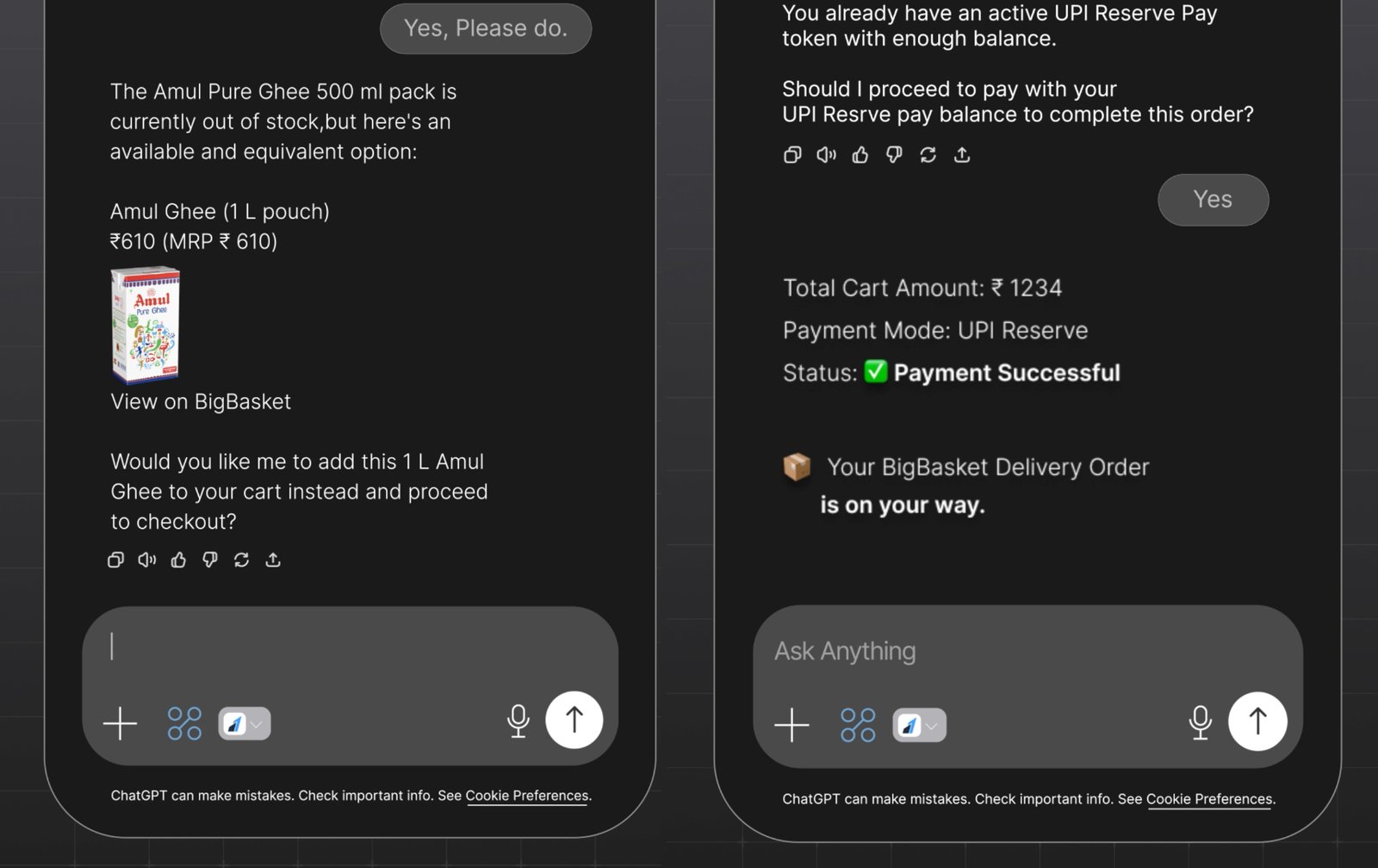
Transforming Search and Discovery into Direct Commerce
With over one billion internet subscribers, India represents one of OpenAI’s fastest-growing demographics. To capitalize on this massive user base, OpenAI previously launched a localized, budget-friendly “ChatGPT Go” subscription priced under $5 in August. This new commerce integration represents the next phase of deep consumer engagement.
“It’s not just a payment experience,” explained Razorpay co-founder and CEO Harshil Mathur. “It’s a whole new discovery and commerce experience.”
India’s sovereign payment network, UPI, currently processes upwards of 20 billion transactions per month. By embedding these payments directly into conversational AI, the NPCI aims to capture a new segment of tech-savvy consumers who prefer interactive, natural-language shopping over traditional search filters and checkout forms.
Gemini and Claude Integrations on the Horizon
The conversational commerce ecosystem will not remain exclusive to OpenAI. Razorpay has already finalized a proof-of-concept for this agentic payment framework with Google’s Gemini and Anthropic’s Claude. According to Mathur, these alternative integrations are slated to go live for consumers within a matter of weeks.
Razorpay is actively onboarding additional enterprise merchants beyond BigBasket and Vi, preparing for a massive scale-up over the next two months. This aggressive expansion aligns with efforts by Google and Anthropic to localize their respective AI offerings and secure user retention in India’s highly competitive digital landscape.
Data Privacy and Security Measures
Addressing potential security concerns, Mathur clarified that AI companies will not have access to sensitive financial or transaction data. Users must explicitly pre-authorize all purchases initiated by the chatbot via secure two-factor authentication (2FA), ensuring that control remains entirely in the consumer’s hands.
Furthermore, this initial pilot operates without a complex revenue-sharing model among partners. Instead, the immediate value proposition for AI developers lies in driving daily active usage and building long-term user loyalty.
The Global Rise of Agentic Commerce
The pilot in India mirrors a broader global shift toward autonomous AI transactions. Recently, OpenAI introduced its “Instant Checkout” feature alongside an Agentic Commerce Protocol developed in tandem with Stripe. Google countered with its own Agent Payments Protocol, designed to let digital assistants execute transactions autonomously on behalf of users.
“This is still an early, forward-looking concept, but one with tremendous potential. Its adoption will naturally grow in line with how fast shopping agents take off,” noted Reeju Datta, co-founder of Cashfree Payments.
Alternative Merchant Solutions
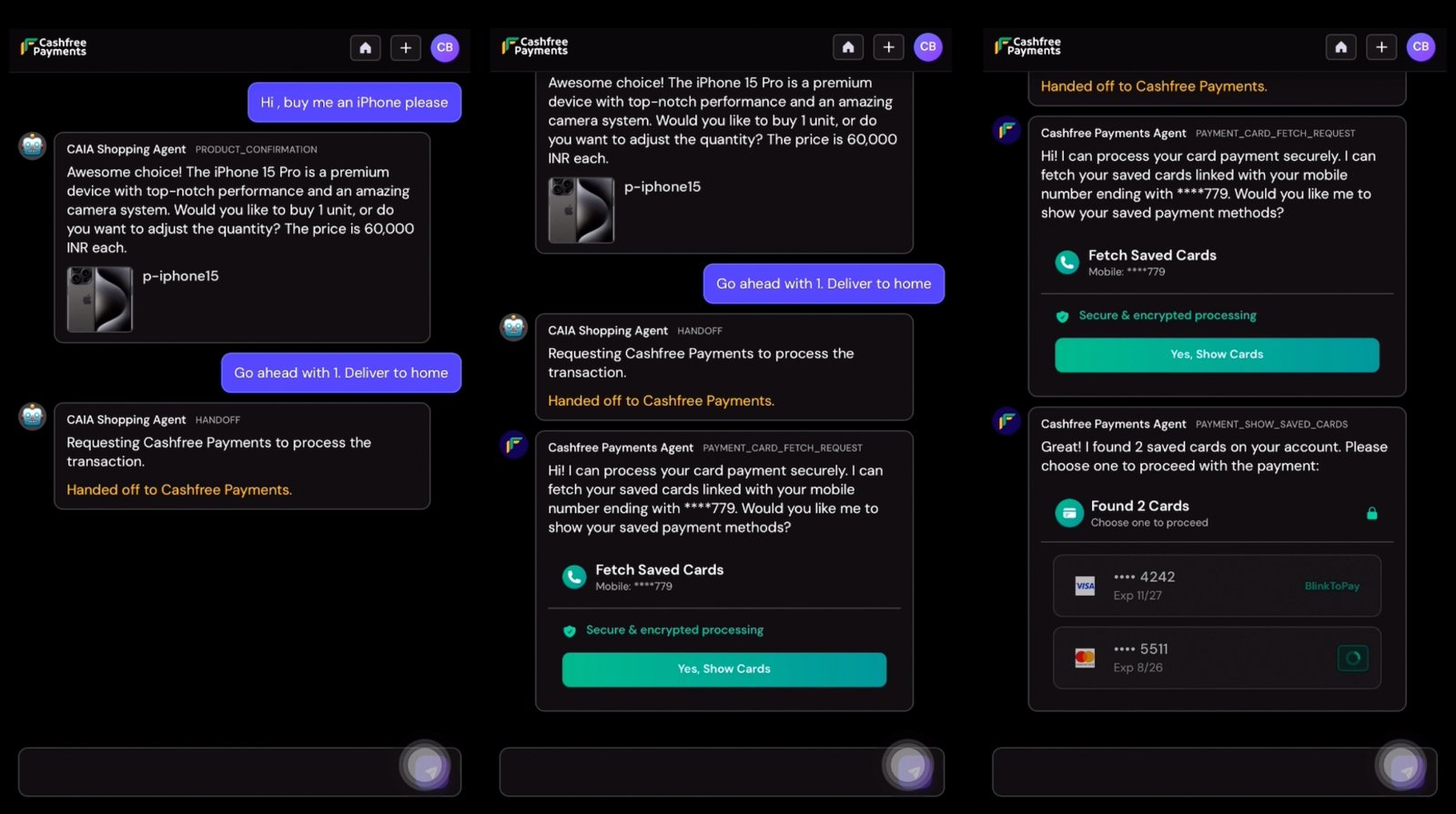
Competition in the space is heating up. Cashfree Payments, another prominent player in India’s merchant processing sector, recently launched its own Agentic Payments MCP (Merchant Commerce Protocol). Unlike Razorpay’s end-to-end managed pilot, Cashfree’s solution provides the payment infrastructure—supporting credit cards and UPI—but requires merchants to build and host their own custom shopping agents.
To demonstrate the feasibility of the technology, Cashfree released a video showcase illustrating an AI assistant executing the entire purchase journey for an iPhone. While Datta declined to name the specific brands currently testing their system, he confirmed that Cashfree is in active discussions with major enterprise merchants spanning retail, e-commerce, and digital lending.