
Jeff Bezos: Stop Taxing the Bottom Half of Americans
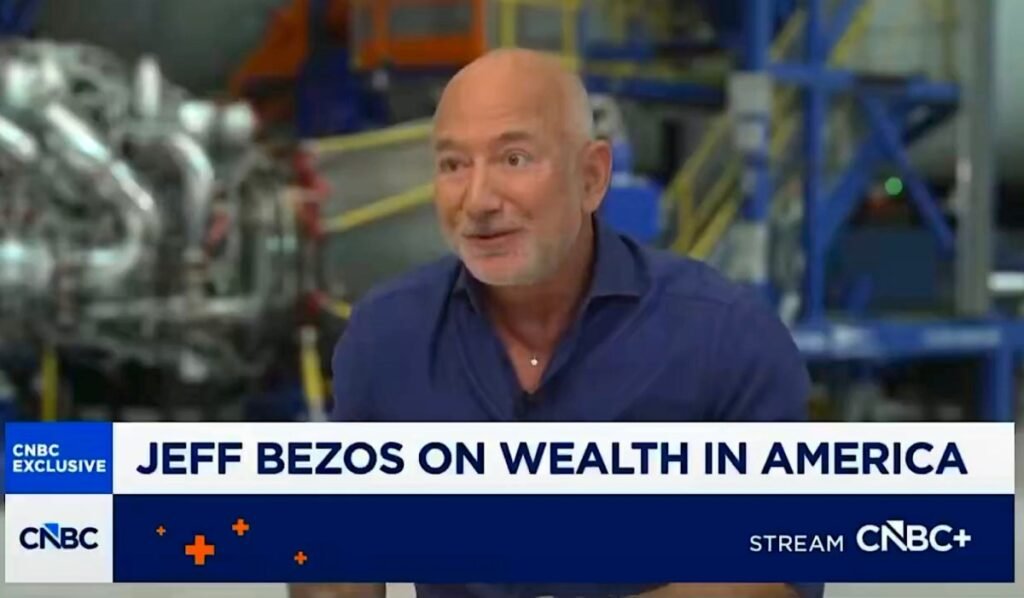
During a interview on CNBC on Wednesday morning, May 20, 2026, Amazon founder Jeff Bezos argued that working-class Americans earning in the bottom half of incomes should be entirely exempt from federal income taxes because their contributions are negligible to the federal budget but financially devastating to their households.
The Financial Burden on Working-Class Families
To illustrate his point, Bezos pointed to the financial struggles of everyday workers who bear a heavy tax burden relative to their earnings.
“Why is a nurse in Queens who makes $75,000 a year paying more than $1,000 a month in taxes?” Bezos asked. “That’s $1,000 that could help with rent, or groceries, or anything … To me, it’s kind of absurd that we’re doing this. We shouldn’t be asking this nurse in Queens to send money to Washington. They should be sending her an apology.”
Jeff Bezos said the bottom half of Americans should pay zero federal income tax.
He cited a nurse in Queens making ~$75K and paying ~$12K in taxes saying “we shouldn’t be asking this nurse in Queens to send money to Washington.” pic.twitter.com/8KSgrO5TnE
— Shay Boloor (@StockSavvyShay) May 20, 2026
According to Bezos, the bottom 50% of U.S. earners contributes just 3% of total federal tax revenue. Despite this minimal collective impact, individuals within this bracket, like the Queens nurse, sacrifice roughly 16% of their annual salary. This means working-class citizens pay a high personal price to generate what amounts to a rounding error in the federal budget.
The Billionaire Tax Avoidance Loophole
This expression of empathy comes from one of the world’s wealthiest individuals, whose own tax practices have drawn intense scrutiny. Ultra-wealthy individuals frequently leverage legal gaps in the tax code to pay income tax on only a fraction of their wealth accumulation. In both 2007 and 2011, Bezos paid zero federal income tax.
A ProPublica investigation revealed that while Bezos’ wealth surged by $127 billion between 2006 and 2018, he reported $6.5 billion in income. Although this resulted in a $1.4 billion tax payment, it represented a true tax rate of only about 1% relative to his wealth growth.
How the Ultra-Wealthy Avoid Income Taxes Legally
Under current U.S. tax law, unrealized capital gains are not taxed. When Amazon’s stock value rises, Bezos does not owe taxes on those gains until he sells the shares. To fund their lifestyles without triggering tax liabilities, billionaires often secure massive loans using their investment portfolios as collateral. Because loan proceeds are classified as debt rather than income, they remain completely tax-free.
A Spending Problem, Not a Revenue Problem
During the interview, CNBC journalist Andrew Ross Sorkin pressed Bezos on the contrast between his tax proposals and his personal wealth accumulation, referencing political criticisms of the current system.
“[Senator] Elizabeth Warren has made this point repeatedly … you and others are able to pay a lower tax rate — even though you’re paying an enormous sum in taxes — a lower tax rate than maybe I am, for example,” Sorkin noted.
Bezos dismissed the idea that raising taxes on billionaires is the solution, asserting instead that the United States suffers from a spending problem rather than a lack of revenue.
“We already have the most progressive tax system in the world,” Bezos stated. “The top 1% of taxpayers pay 40% of all the tax revenue. The bottom half pay only 3%.”
Bezos on CNBC: "You could double the taxes I pay, and it's not gonna help that teacher in Queens. I promise you." pic.twitter.com/ocbf34XZhA
— Aaron Rupar (@atrupar) May 20, 2026
Even after liquidating Amazon shares to fund his aerospace venture, Blue Origin, Bezos continues to pay a lower effective tax rate than many middle-class Americans.
“If people want me to pay more billions, then let’s have that debate. But don’t pretend that that’s going to solve the problem,” Bezos argued. “You could double the taxes I pay, and it’s not going to help that [nurse] in Queens.”
The Debate Over Government Efficiency
Critics argue that even within a $7.4 trillion federal budget, the billions of dollars in additional tax revenue from the ultra-wealthy could fund critical public services.
For a working-class citizen, those additional funds could translate into tangible benefits: reliable public transportation, well-funded public schools with adequate supplies, and accessible healthcare free from the threat of catastrophic medical debt.
However, Bezos expressed skepticism about the federal government’s ability to allocate capital effectively.
“If you really want to have a progressive tax system, you also want that money to actually be helping and not just dissolving in, you know, in like administrative bureaucracy,” Bezos added.
For average citizens, money is not an abstract economic metric but a finite resource managed biweekly to cover immediate necessities like rent, groceries, transportation, and debt. While critics may view the prospect of billionaires paying higher taxes to fund public infrastructure as idealistic, proponents argue it is no more complex than attempting to build data centers on the moon.