
OpenAI Launches In-Chat Buying to Fight Google, Amazon
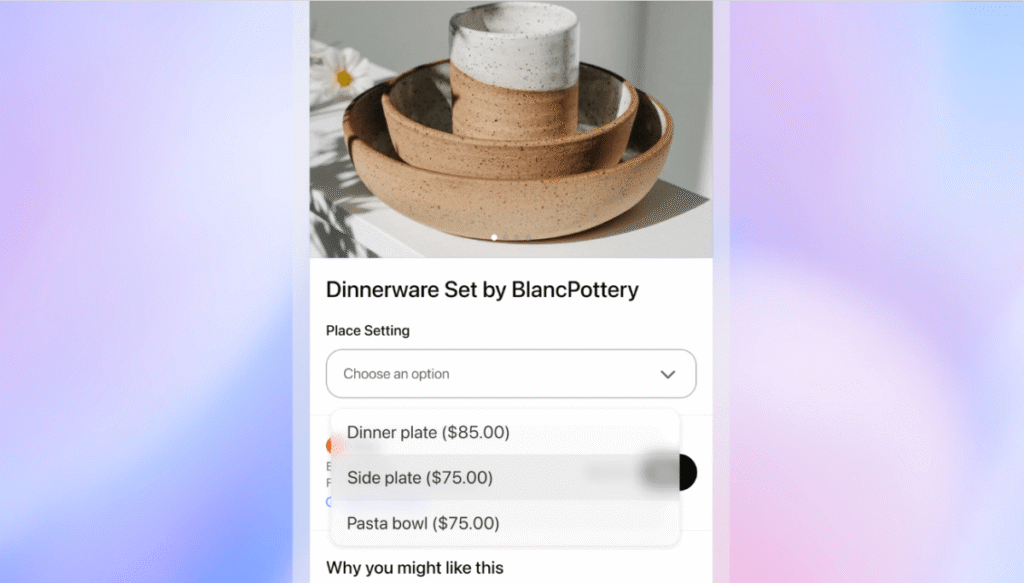
OpenAI launched a new “Instant Checkout” feature on ChatGPT this week in the U.S., allowing users to purchase products directly from Etsy and Shopify within their chat conversations to challenge the e-commerce dominance of Google and Amazon.
The new feature is immediately available to logged-in ChatGPT Free, Plus, and Pro users purchasing from U.S.-based Etsy sellers. OpenAI confirmed that integration for over 1 million Shopify merchants—including major brands like Glossier, Skims, Spanx, and Vuori—is coming soon.
How ChatGPT’s Instant Checkout Works
This update advances ChatGPT beyond merely recommending products to executing transactions. Previously, the chatbot could suggest items, display images, show reviews, and provide direct links in response to queries like “what is a good gift for a ceramic lover?” Now, users can complete their purchases instantly by clicking a “Buy” button inside the chat interface, which securely processes shipping and payment details via Apple Pay, Google Pay, Stripe, or credit cards.
This frictionless transaction model mirrors recent moves by other AI companies. Last year, Perplexity introduced a comparable in-chat purchasing and payment feature, while Microsoft launched its Copilot Merchant Program to help retailers build storefronts directly within its AI assistant.
Challenging the E-Commerce Gatekeepers
By removing the need to jump to external websites, OpenAI could trigger a paradigm shift in digital retail. This transition moves consumers away from traditional search engines like Google and marketplaces like Amazon, redirecting them toward conversational AI agents that offer curated suggestions, comparisons, and seamless checkouts.
Consequently, this shift is poised to establish new power dynamics in e-commerce. Google and Amazon have historically controlled retail product discovery. If AI chatbots become the primary starting point for shopping journeys, the developers behind these models will gain significant influence over product visibility, search rankings, and transaction fees.
While Google and Amazon have faced criticism for leveraging their market dominance to promote their own products or charging high seller fees, OpenAI claims a different approach. The company stated that its product recommendations are completely organic, unsponsored, and ranked solely on relevance, though it will charge merchants a small fee on completed purchases.
The Agentic Commerce Protocol and Stripe Integration
Alongside the consumer-facing launch, OpenAI announced it is open-sourcing its Agentic Commerce Protocol (ACP). Developed in partnership with Stripe, ACP is the underlying technology powering the Instant Checkout system. Open-sourcing this protocol allows external developers and merchants to integrate agentic checkouts into their own platforms.
“Stripe is building the economic infrastructure for AI,” stated Will Gaybrick, president of technology and business at Stripe. He noted that this involves re-architecting modern commerce systems to deliver new AI-driven experiences globally.
Addressing potential privacy and security concerns regarding financial data, OpenAI clarified that ChatGPT does not process or store payment information directly. Instead, the chatbot functions as a secure intermediary, passing transaction details to the merchant, who handles order fulfillment and payment processing through their existing infrastructure.
The Battle of Open Protocols: OpenAI vs. Google
By making ACP open-source, OpenAI aims to accelerate the adoption of AI chatbots as virtual storefronts. This move positions the company to potentially become the primary architect of the emerging AI-driven commerce ecosystem. However, this strategy places OpenAI in direct competition with Google, which recently introduced its own open-source framework for AI-initiated transactions, known as the Agent Payments Protocol (AP2).