
Theory Ventures Leads $14M Bet on ‘iOS for Web3’ Initia

Theory Ventures has invested $12.6 million to lead a $14 million Series A funding round for Initia, a Web3 startup building an interoperable network to simplify decentralized application development globally.
While blockchain technology has long promised to revolutionize global systems, it has largely functioned as a speculative vehicle for new assets due to extreme development barriers. Tomasz Tunguz, the veteran venture capitalist renowned for his popular startup blog and high-profile SaaS investments at Redpoint Ventures, believes Initia is the key to dismantling these technical hurdles.
This fresh capital injection, representing roughly 90% of Initia’s newly closed Series A, values the startup’s token ecosystem at $350 million. Notably, the transaction represents the first dual equity-and-token investment executed by Theory Ventures.
Theory Ventures is currently deploying its $230 million inaugural fund across approximately 12 early-stage startups, concentrating on three core sectors: data infrastructure, artificial intelligence, and blockchain technology.
“Ethereum is worth seven Snowflakes put together,” Tunguz noted, contrasting the second-largest blockchain network with the enterprise cloud data giant. At the time of his assessment, Ethereum’s market capitalization hovered around $293 billion, while Snowflake’s valuation stood at $37 billion. Tunguz emphasizes that these next-generation decentralized databases and programming platforms are poised to generate massive market outcomes.
This latest financing round elevates Initia’s cumulative funding to $22.5 million, building on previous financial backing from prominent industry players including Delphi Ventures, Hack VC, and Binance Labs.
Solving the Fragmented Web3 Development Landscape
Building decentralized applications remains a highly fragmented process. Instead of deploying on general-purpose Layer 1 networks like Ethereum or Solana, modern developers are increasingly opting for specialized “app chains” tailored to deliver specific performance metrics, such as enhanced transaction speeds and robust security.
However, these customized chains typically operate in silos, lacking native interoperability. Initia addresses this critical bottleneck by positioning itself as the “iOS for Web3.” The startup operates a Layer 1 network designed to offer disparate app chains seamless programming compatibility while preserving their flexibility to customize individual execution environments.
“If you want to build an application inside of Web3, it’s a five-layer cake,” Tunguz explained. “You probably want to start with a reasonable cake and, as you grow, swap out different layers.” These layers encompass fundamental blockchain operations like consensus—where network validators agree on ledger states—and data availability, where state records are published.
Developers frequently require the ability to adjust the underlying performance characteristics of decentralized databases without sacrificing network security. According to Tunguz, financial applications demand ultra-low latency, whereas other use cases prioritize maximum security, which is where roll-ups-as-a-service (RaaS) or Layer 2 solutions come into play.
“Initia combines both of those innovations plus instant compatibility with most of the blockchains,” Tunguz stated. “If you are a developer, it’s a great place to start because you have great defaults.”
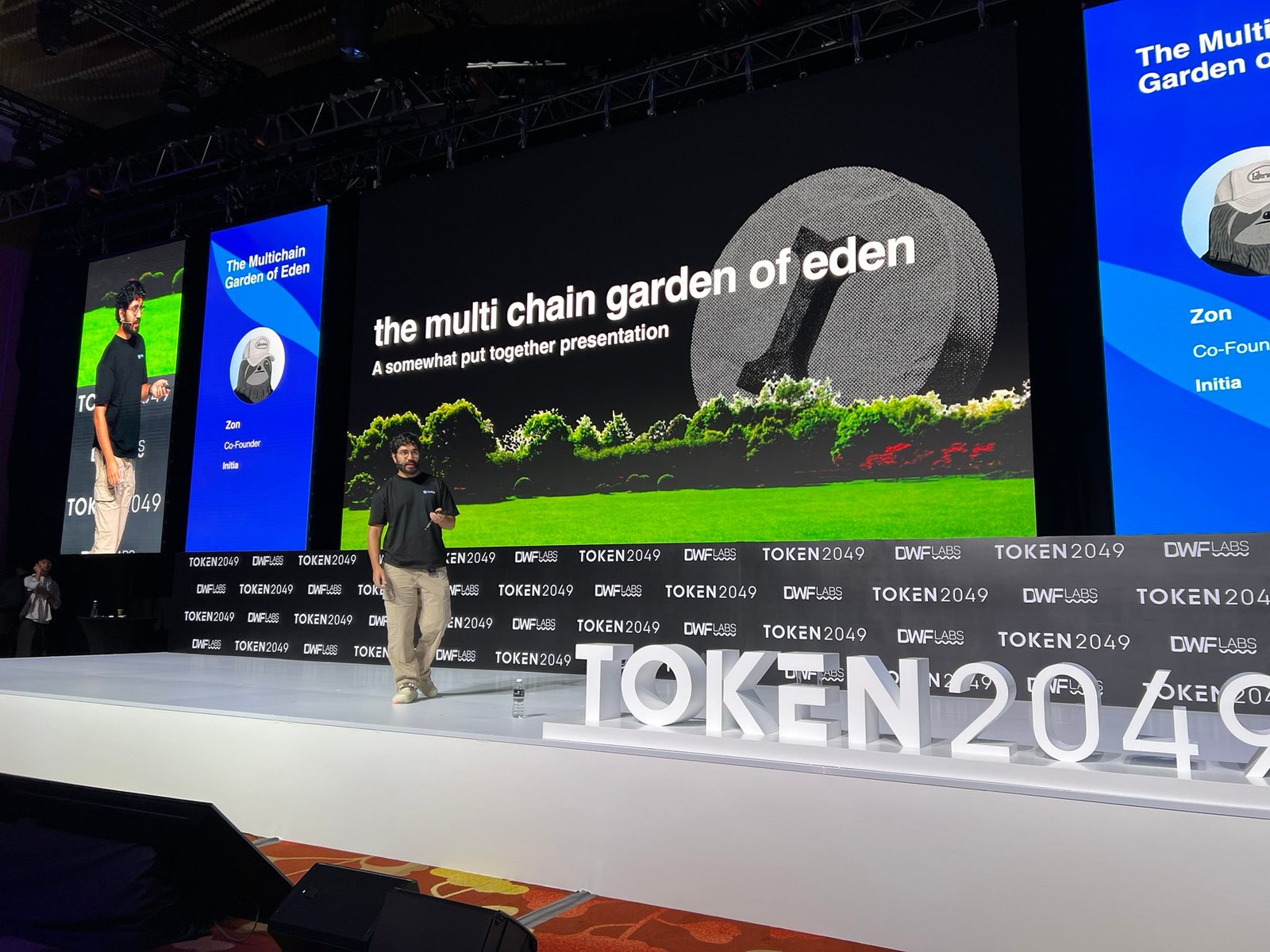
A unified development environment also streamlines cross-network capital movement, boosting overall liquidity and delivering a smoother user experience. Initia co-founder Stan Liu illustrated this by detailing how the platform optimizes decentralized prediction markets, which have seen a surge in popularity due to major political events.
“Recently, with all the presidential debates, prediction markets have come to the forefront again,” Liu explained. “The big problem is that in order to facilitate all these types of trades and have actual volume, you need a really big amount of underlying liquidity on the protocol itself.”
Liu pointed to Polymarket, a prominent prediction platform, as an example of current user friction. To make a bet, users must deposit USDC stablecoins, which requires paying transaction fees (gas) in ETH on the Polygon network. This process forces users to acquire ETH from an exchange, bridge it to Polygon, and utilize an EVM-compatible wallet to execute trades.
In contrast, Contro, an Initia-powered prediction market, allows users to place wagers using any cryptocurrency and any wallet. This seamless interaction is possible because Initia supports multiple blockchain execution environments, allowing app chains written on different frameworks to settle and interact on its core network.
Why Mainstream VCs Are Backing Token-Based Models
Theory’s investment in Initia underscores the ongoing appetite among mainstream venture capital firms for Web3 startups, despite volatile cryptocurrency prices and broader skepticism regarding blockchain’s utility beyond financial speculation. The deal includes a token warrant, granting Theory the right to acquire Initia’s native tokens upon any future public launch.
Spencer Farrar, a partner at Theory Ventures, highlighted the strategic value of token-based models. “One, how do you bootstrap open source development and encourage a fruitful ecosystem? A token can play a part in that,” Farrar said. “I’m taking a company public and raising money, which historically has been a long and expensive process, and potentially, tokens offer access to global actors.”
Farrar, who previously built a project on Solana, also pointed to Initia’s strong developer relations as a key differentiator. He noted that co-founders Zon and Stan pair deep technical expertise with a collaborative approach, attracting projects that utilize Move—an open-source programming language originally developed at Meta and now used by major blockchains like Aptos and Sui.
Despite the industry excitement surrounding app chains, the ecosystem remains in its infancy. Co-founder Ezaan Mangalji estimates that only about 50 app chains are currently undergoing active development. Today, eight projects are actively testing on Initia as the startup prepares for its mainnet launch within the next two months. The testnet has already registered over 125 million transactions across nearly 3 million unique wallets.
Tunguz remains highly optimistic about how modular solutions like Initia will scale the broader multichain landscape. He noted that by modularizing databases and separating components like data availability and execution, developers are successfully optimizing performance across different segments of the database stack.
“The other reason is just we’ve seen 600-700x improvement in blockchains in the last three years,” Tunguz concluded, pointing to tangible proof that diverse architectural designs are driving substantial performance gains across the industry.