
DoorDash Unleashes Autonomous Delivery Robots in LA
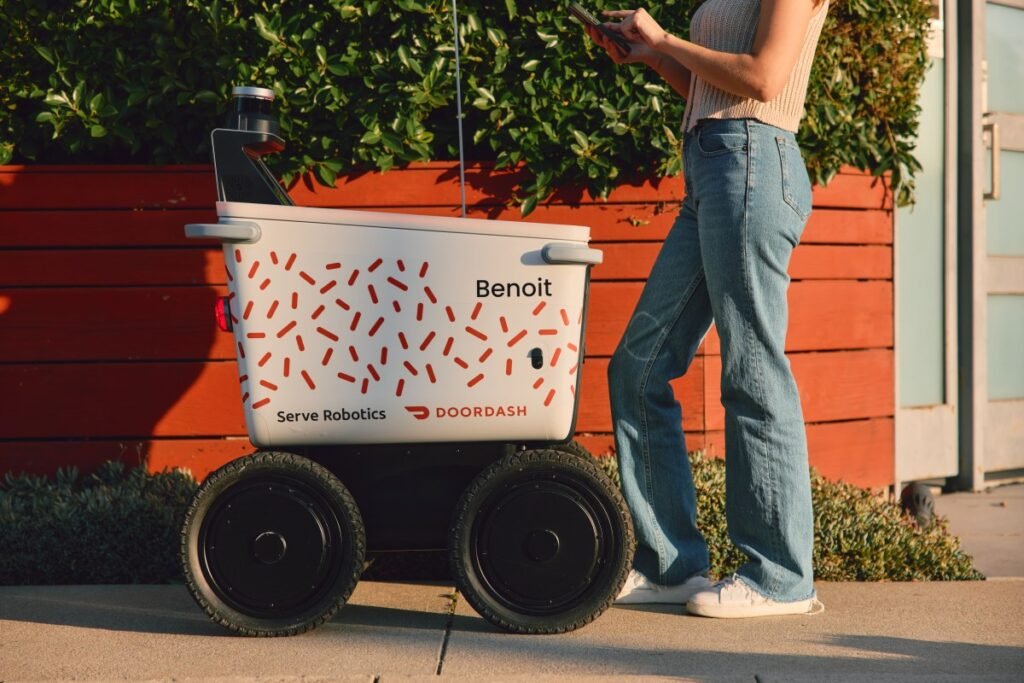
DoorDash launched a multi-year partnership with Serve Robotics on Thursday to deploy autonomous sidewalk delivery robots across Los Angeles, aiming to scale its high-tech, multimodal delivery network.
A New Era of Autonomous Deliveries in California
The collaboration marks a significant expansion of robotic food delivery in Southern California, allowing local DoorDash customers to have their orders transported by Serve’s specialized sidewalk bots. This nationwide partnership is designed to scale robotic deliveries across major U.S. markets over the coming years.
The announcement comes just one week after DoorDash introduced Dot, its proprietary autonomous delivery robot. Dot is currently undergoing its initial deployment in the Phoenix metropolitan area. While Serve’s units are designed primarily to navigate sidewalks, Dot is engineered to operate across roads, bicycle lanes, and sidewalks, reaching speeds of up to 20 miles per hour to transport food and small parcels.
Building a Multimodal Delivery Ecosystem
Serve Robotics is the latest addition to DoorDash’s growing portfolio of advanced automation partnerships. The delivery giant has already established alliances with sidewalk bot startup Coco and drone delivery specialist Wing. According to Ashu Rege, Vice President of Autonomy at DoorDash Labs—the company’s dedicated robotics and automation division—these initiatives are part of a strategic roadmap to establish a comprehensive, multimodal delivery platform.
Navigating the Competitive Autonomous Landscape
DoorDash is not alone in exploring autonomous logistics. Uber has aggressively pursued partnerships with self-driving vehicle developers across its rideshare, delivery, and freight networks. Serve Robotics already maintains an active partnership with Uber, meaning its autonomous fleet will operate dynamically across both competing platforms, much like independent gig workers.
However, DoorDash is carving out a distinct path by developing its own hardware alongside third-party integrations. Other industry players have previously struggled with this dual-track strategy. Uber and Lyft both abandoned efforts to manage both autonomous vehicle development and their respective ride-hailing networks. Similarly, autonomous vehicle developer Nuro pivoted away from manufacturing its own custom delivery vehicles after discovering the immense capital requirements of hardware production.
Why DoorDash Believes It Can Succeed Where Others Failed
Despite historical industry challenges, Rege remains confident in DoorDash’s proprietary hardware strategy. The company intends to manufacture its Dot robots at scale, though specific production details remain proprietary. DoorDash is leveraging strong financial momentum, having achieved its first profitable year in 2024 and reporting record profits during the first half of 2025, driven by a 20% year-over-year increase in order volumes. Rege emphasizes that expanding delivery modalities is critical to supporting this expanding user base.
Solving the “Last 10 Feet” Problem
According to Rege, the Dot robot addresses a specific operational gap that existing technologies overlook. While sidewalk robots excel in ultra-dense urban environments and robotaxis are optimized for passenger transport, neither solves the micro-logistics of final delivery. Merchants do not want to walk half a block to load a vehicle, and consumers expect their food delivered directly to their doorstep.
Dot is positioned to bridge this gap in dense suburban environments, operating efficiently within a three-to-five-mile radius. Its hybrid capability to transition seamlessly between roads and sidewalks is central to its operational design. While human couriers remain the most versatile option, DoorDash plans to reallocate human labor toward more complex grocery, retail, and multi-stop restaurant deliveries, leaving short-distance, standardized runs to its autonomous fleet.